
Tree Maintenance Tips to Avoid Storm-Related Issues
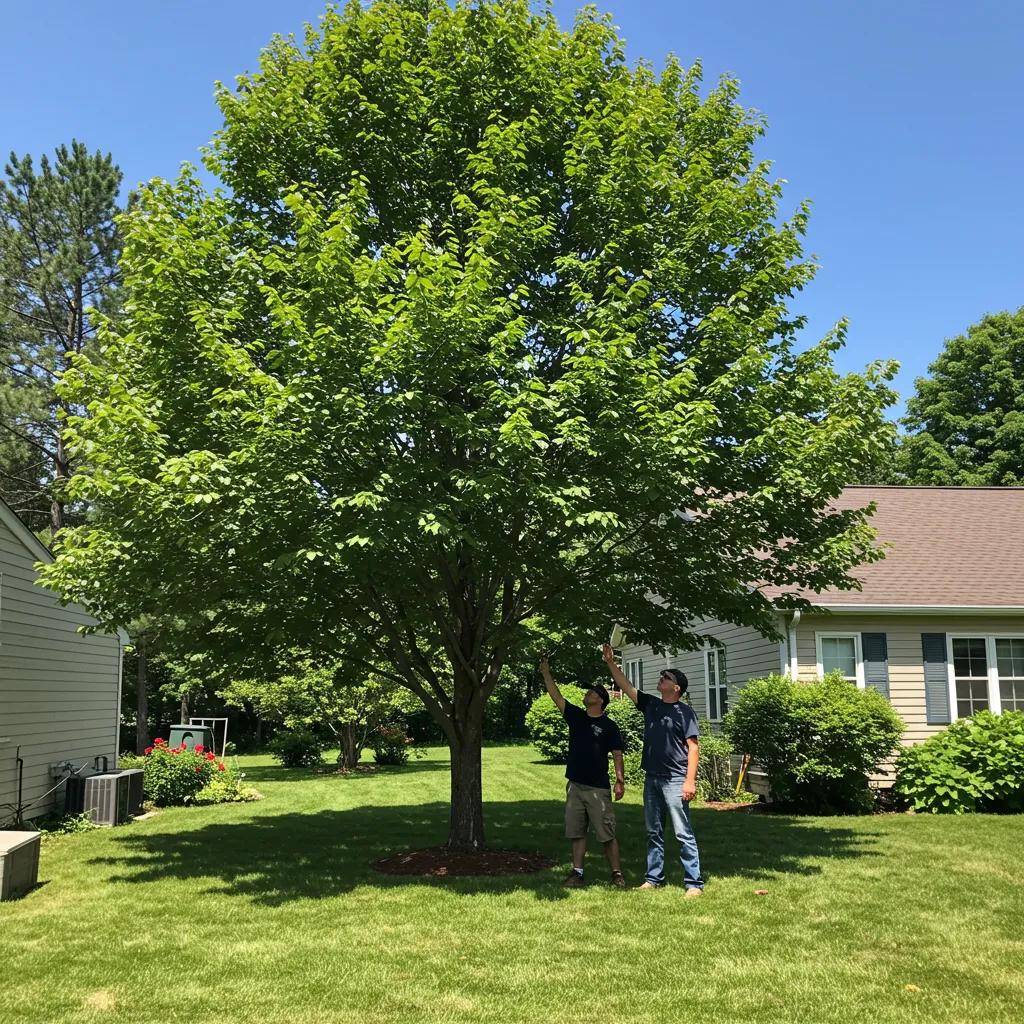
Prevent Tree Emergencies in Jacksonville with Proactive Care
A tree emergency occurs when a tree or major limb presents an immediate risk to people, structures, utilities, or safe egress from a property. Homeowners face both safety and financial consequences if hazards are not addressed. This guide explains how proactive tree care, targeted inspections, and timely maintenance reduce the chances of catastrophic failure, lower repair costs, and keep families safe through hurricane season and beyond. You will learn to recognize hazardous tree signs, understand what professional tree risk assessments include, and follow practical maintenance and pre-storm checklists tailored to homeowners in Jacksonville, Florida. The article maps clear actions—inspection cadence, pruning priorities, support systems like cabling and bracing, and what to do after a storm—so you can prioritize work by risk and cost. Throughout, we weave guidance on when to call licensed professionals and what to expect from emergency and preventative services, with concrete comparison tables and homeowner-focused examples. Start by learning the most common causes of tree emergencies and the early warning signs to watch for in your landscape.
What Are the Common Causes of Tree Emergencies Near You?
Tree emergencies most often arise from a small set of triggers: extreme weather, internal decay, root failure, pest and disease pressure, and poor structural form created by past pruning or storm damage. Each mechanism undermines a tree’s ability to resist wind and gravity, producing failures like limb breakage, stem snapping, or uprooting that directly threaten property and people. Identifying these causes early lets homeowners prioritize interventions that mitigate risk and extend tree life. Below are the core causes and quick examples connecting cause to likely failure mode and homeowner action.
- Severe weather: High winds and saturated soils increase uprooting and limb blowout risk; secure or remove high-exposure trees before storm season.
- Decay and cavities: Fungal conks and internal rot weaken stems and attachment points; schedule a professional inspection to confirm structural integrity.
- Root issues: Construction damage, root rot, or leaning from root plate failure reduce anchorage and can lead to sudden toppling.
- Pests and disease: Infestations that defoliate or hollow branches escalate failure probability; early detection limits spread and structural compromise.
- Poor pruning or included bark: Weak branch unions and excessive crown density concentrate wind loads and promote branch separation.
Homeowners should use visual checks after storms and during seasonal maintenance windows to catch these conditions early and take temporary safety steps while arranging a professional evaluation, which leads into how risk assessments formalize that process.
How Do Storms and Weather Events Trigger Tree Emergencies?
Storms trigger tree emergencies by combining force and environmental change: wind imparts dynamic loads to crowns while saturated soils reduce root-soil friction, making windthrow and root plate failure more likely. Lightning can shatter trunks or cause deep wood damage that later becomes a point of structural failure, and storm surge or coastal flooding accelerates root decline in susceptible species. Understanding these failure modes helps homeowners prioritize mitigation—thinning dense crowns, removing hazardous limbs, and avoiding heavy pruning immediately before storm season to reduce open wounds. After recognizing how storms act on trees, the next consideration is internal tree health issues that quietly increase risk over time.
What Tree Health Issues Lead to Emergency Situations?
Internal decay, root rot, heartwood cavities, and chronic pest infestations all reduce a tree’s structural capacity and turn otherwise stable specimens into hazards. Decay fungi often produce external signs—conks, hollows, or brittle wood—that signal hidden structural loss, while root diseases manifest as reduced canopy vigor and subsidence around the trunk. Pests such as borers or wood-boring insects accelerate branch failure by eating supporting tissues, and repeated canopy dieback concentrates loads on remaining branches. Monitoring and early treatment of disease or pests prevents escalation and is a logical complement to structural inspections, which we describe in the next section.
How Can Homeowners Identify Hazardous Tree Signs Early?
Homeowners can perform simple visual checks to flag red flags: large cracks, trunk splits, fungal fruiting bodies, new or sudden trunk lean, root heave, and persistent deadwood are all indicators of elevated risk. Routine walk-around inspections—especially after high winds or heavy rains—should focus on the trunk base, major branch unions, and the root flare where soil should not hide roots or collar rot. Photograph suspicious conditions and avoid DIY removals of large limbs; instead, secure the area and contact a certified professional when safety is uncertain. Regular homeowner checks provide the data professionals need during a formal tree risk assessment, which is the next critical prevention step.
How Does a Tree Risk Assessment Help Prevent Emergencies?
A tree risk assessment is a structured evaluation performed by a trained arborist to identify hazards, estimate likelihood and consequence of failure, and recommend specific mitigations such as pruning, cabling, monitoring, or removal. The process converts visual and diagnostic observations into an actionable plan that reduces immediate hazards and guides long-term maintenance. Assessments prioritize work by risk level so homeowners apply limited resources where they most reduce potential damage. Below is a compact EAV-style table outlining common inspection components, what is checked, and why each element matters to homeowners.
A professional inspection typically covers canopy structure, trunk condition, root zone, soil and drainage, and evidence of pests or disease; the table below maps these components to homeowner actions.
| Inspection Component | What Is Checked | Why It Matters / Homeowner Action |
|---|---|---|
| Canopy & Branch Unions | Deadwood, included bark, heavy limbs | Identifies limbs to prune or cable to reduce failure risk |
| Trunk & Wood Integrity | Cracks, cavities, fungal conks | Reveals internal decay that may require removal or bracing |
| Root Collar & Soil | Root heave, compaction, drainage | Shows anchorage problems and helps guide root care or excavation |
| Pest & Disease Signs | Insect galleries, dieback, leaf symptoms | Determines treatment urgency and containment steps |
| Site & Targets | Proximity to structures, utilities, egress routes | Prioritizes trees posing highest consequence if they fail |
This table clarifies inspection scope and helps homeowners understand recommended actions and expected outcomes; scheduling cadence is the next practical question that follows from assessment benefits.
If you prefer a professional inspection, Bushor’s Tree Surgeons offers Tree Health Assessment services performed by ISA Certified arborists who evaluate these components and deliver clear mitigation plans. To schedule an assessment or ask about recommended follow-up, call 904-789-8884. (bushortree.com)
What Is Included in a Professional Tree Health Inspection?
A professional inspection begins with a visual survey and then uses diagnostic methods—sounding, probe tests, and sometimes imaging—to estimate decay extent and load-bearing capacity. The arborist documents structural defects, assesses root health, and ranks each tree by risk and impact potential, then recommends interventions like structural pruning, cabling, or targeted removal. Final deliverables typically include a written report, photographic evidence, and a prioritized work plan that homeowners can use for budgeting or insurance documentation. Knowing the inspection components helps homeowners ask focused questions and prepare the property for safe, efficient evaluation.
The process of evaluating tree risks involves specific methodologies that arborists employ to ensure thoroughness and consistency.
Evaluating Tree Risk Assessment Methods for Homeowners
Tree risk assessment methods have been developed to assist arborists in conducting thorough and systematic inspections of trees and the threat they pose to people or property. While these methods have many similarities, they also have a few key differences which may impact the decisions of those employing them. Moreover, arborists specify the associated timeframe for their risk assessment, which can range from months to years. How this impacts risk assessment reproducibility is unknown.
Evaluating the reproducibility of Tree Risk Assessment ratings across commonly used methods, RW Klein, 2023
How Often Should Homeowners Schedule Tree Risk Assessments?
Inspection frequency depends on tree age, species, location, and exposure: newly planted trees need seasonal checks during establishment, mature healthy trees benefit from annual inspections, and high-risk trees or those near structures should be inspected after storms or construction. Trigger events—severe weather, visible decline, or nearby excavation—warrant immediate reassessment regardless of the routine schedule. An adaptive schedule that increases frequency for vulnerable trees reduces the likelihood of surprise failures while keeping inspection costs proportional to risk, leading naturally into why ISA certification matters for these evaluations.
What Are the Benefits of Hiring ISA Certified Arborists for Tree Evaluations?
ISA Certified arborists bring standardized training, up-to-date best practices, and objective risk assessment frameworks that improve diagnostic accuracy and safety during work. Certified professionals are more likely to recommend proportionate interventions—avoiding unnecessary removals while addressing genuine hazards—and to perform work that preserves long-term tree health. Hiring a credentialed arborist increases confidence in the findings, makes it easier to document maintenance for insurance, and generally results in safer, more effective mitigation strategies. Understanding maintenance techniques then informs routine care that prevents many emergencies in the first place.
What Are the Essential Tree Maintenance Practices to Prevent Emergencies?
Essential maintenance practices—structural pruning, pest and disease control, watering and mulching, and root-zone protection—create resilient trees that resist wind loading and recover from damage. Regular pruning shapes strong branch attachments and removes weak wood, pest control stops health decline before structural compromise occurs, and soil care supports root anchorage and nutrient uptake. Implementing these cultural practices on a schedule tailored to species and site reduces emergency probability and lowers lifecycle costs. The list below outlines prioritized maintenance tasks and the expected benefits when done correctly.
- Structural pruning: Remove crossing or weak branches to improve wind flow and reduce failure points.
- Pest and disease monitoring: Detect infestations early and apply targeted treatments to maintain wood strength.
- Mulching and watering: Preserve root-zone moisture and prevent surface compaction to support anchorage.
- Root protection during construction: Fence critical root zones and avoid grade changes near trunks.
These practices work together to lower failure rates and extend tree life, and the next subsections explain how specific actions like pruning and root care directly reduce storm damage risk.
How Does Proper Pruning and Trimming Reduce Storm Damage Risks?
Proper pruning creates a balanced crown with well-spaced lateral branches and strong branch collars that are better able to shed wind loads without catastrophic breakage. Structural pruning targets codominant stems and poorly attached limbs while removing deadwood that might fail unexpectedly; it also reduces sail area by selective thinning, which lowers wind pressure on the tree. Homeowners should avoid topping and wide-scale crown cutting, both of which increase decay and future failure risk, and hire professionals for larger trees where climbing and rigging hazards exist. Thoughtful pruning now minimizes emergency work later and complements inspection-based mitigation plans.
Why Is Routine Pest and Disease Control Critical for Tree Health?
Pests and pathogens weaken wood and reduce a tree’s capacity to withstand storms by causing branch dieback, cambial decay, and root loss; untreated infestations can convert a stable tree into a high-risk hazard within seasons. Routine monitoring detects early signs—bore dust, canopy thinning, or abnormal leaf symptoms—so timed interventions can halt spread and preserve structural integrity. Integrated approaches combine cultural care, biological controls, and targeted treatments when warranted, and escalation to an ISA Certified arborist is advised for widespread or aggressive outbreaks. Controlling biological stressors preserves both health and the investment homeowners have made in their landscape.
How Do Watering, Mulching, and Root Care Support Tree Stability?
Proper irrigation during dry periods prevents root dieback and maintains turgor necessary for anchorage, while a 2–4 inch mulch ring conserves moisture, moderates soil temperature, and reduces compaction near the root collar. Avoid piling mulch against trunks and keep grade changes away from the root flare to prevent collar rot and buried root flare conditions that degrade stability. Aeration and avoiding heavy traffic over critical root zones help maintain soil porosity and root health, which directly influence a tree’s ability to resist uprooting during storms. Root-focused cultural care is a cost-effective preventative that reduces emergency probability and supports overall tree resilience.
How Can Homeowners Prepare Their Trees for Hurricane and Storm Seasons?
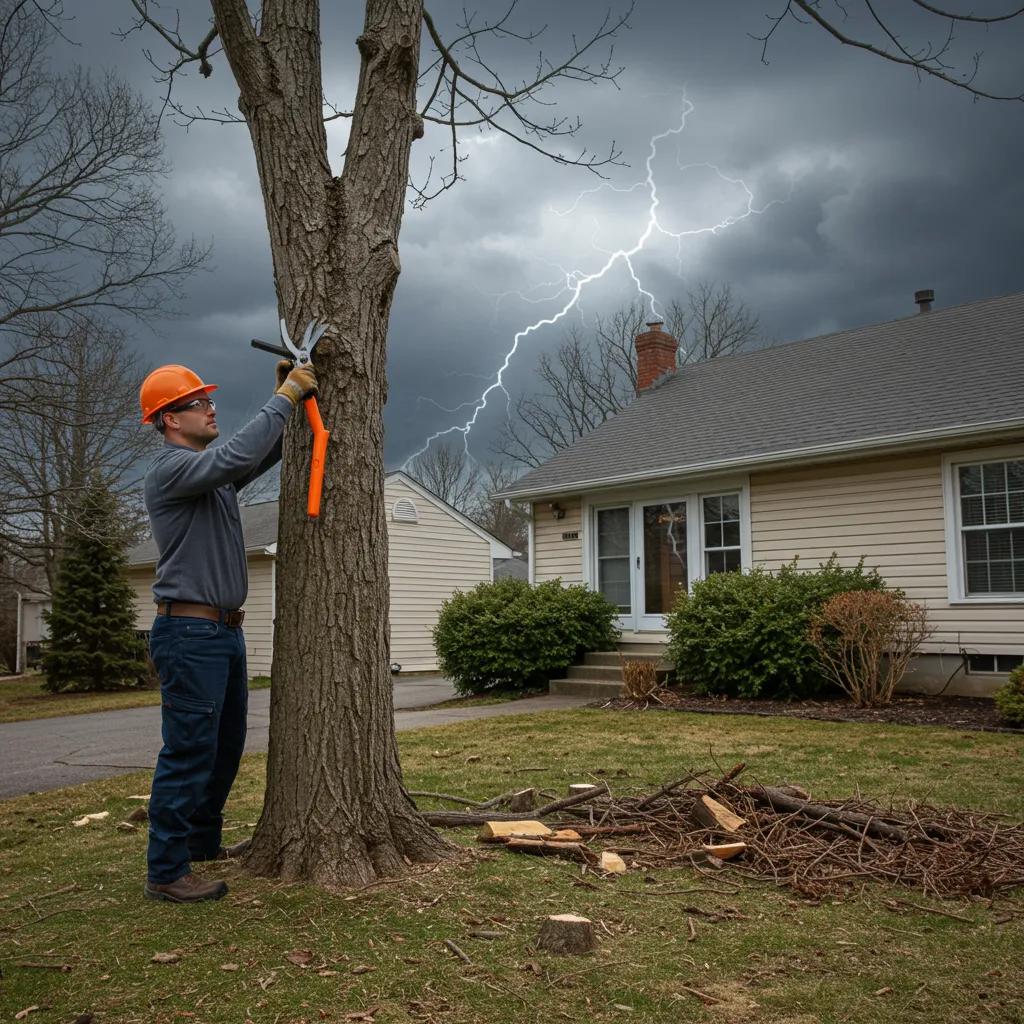
Preparing for hurricane and storm seasons requires a focused pre-storm inspection, selective pruning to reduce sail area, reinforcement for high-value trees through cabling and bracing when appropriate, and securing young trees to prevent uprooting. Timing matters: complete vulnerability-reducing work well before forecast windows to allow pruning wounds to begin healing. A concise checklist below helps homeowners perform safe, preliminary checks and identify conditions needing professional attention. After following the checklist, homeowners should arrange professional work for items beyond safe DIY scope.
- Inspect for deadwood, damaged unions, and overextended limbs at least one month before storms.
- Remove hazardous dead limbs and thin dense crowns to reduce wind resistance.
- Check root flare exposure and correct excessive mulch or soil build-up prior to storms.
- Secure or stake newly planted trees and confirm stakes won’t girdle trunks over time.
This pre-storm preparation lowers failure likelihood and points to whether support systems such as cabling and bracing are warranted, which we explain next and then describe immediate post-storm actions.
A practical pre-storm checklist for homeowners follows; use it to prioritize tasks and document conditions before work begins.
| Task | Recommended Timing / Frequency | Tools / Notes / Safety |
|---|---|---|
| Deadwood removal | 2–6 weeks pre-season | Use pole pruners for small limbs; stop and call pros for large limbs |
| Structural pruning | 1–2 months pre-season | Hire professionals for major cuts; allow wound recovery time |
| Root collar inspection | Annually, pre-season | Clear mulch, inspect for circling roots or root heave |
| Staking young trees | At planting, check monthly | Use flexible ties; remove stakes after 1–2 years to prevent girdling |
| Document trees near structures | Pre-season | Photograph and map high-consequence trees for insurer records |
How Does Tree Cabling and Bracing Strengthen Vulnerable Trees?
Cabling and bracing redistribute mechanical loads within the canopy and between stems, using support cables and threaded rods to reduce movement at weak unions or within multi-stemmed trees. These systems are suited for trees with historic value or those where removal is a last-resort option, but they carry limitations: supports do not stop decay and require inspection and maintenance to remain effective. Professional installation by trained arborists ensures proper placement, appropriate hardware selection, and an understanding of when cabling is a temporary measure versus when removal is the safer alternative. Evaluating the trade-offs between bracing and removal is part of any tree-risk mitigation plan.
What Are the Best Practices for Securing Young and Newly Planted Trees?
When securing young trees, use flexible ties and a single or double stake system that allows trunk movement to encourage taper and root anchorage development, removing supports after one to two growing seasons. Initial pruning should focus on establishing a central leader and removing competing stems to develop strong structure while avoiding over-pruning, which limits root energy. Proper planting depth with visible root collar, appropriate species selection for the site, and ongoing irrigation during establishment are essential steps to set trees up for long-term stability. Secured, well-established trees are far less likely to become emergency candidates during severe weather.
What Immediate Actions Should Be Taken After a Storm to Ensure Safety?
After a storm, prioritize human safety: keep family and neighbors away from downed limbs, avoid contact with downed power lines, and call emergency responders for urgent utility threats. Document damage with photos for insurance, then secure the area to prevent further collapse or entry until a professional assessment can be completed. Do not attempt to remove large fragments yourself; engage a certified arborist for safe removal and temporary shoring where needed. These immediate steps protect life and property and speed recovery by providing clear documentation and reducing secondary damage.
When Should You Call Emergency Tree Removal Services Near You?
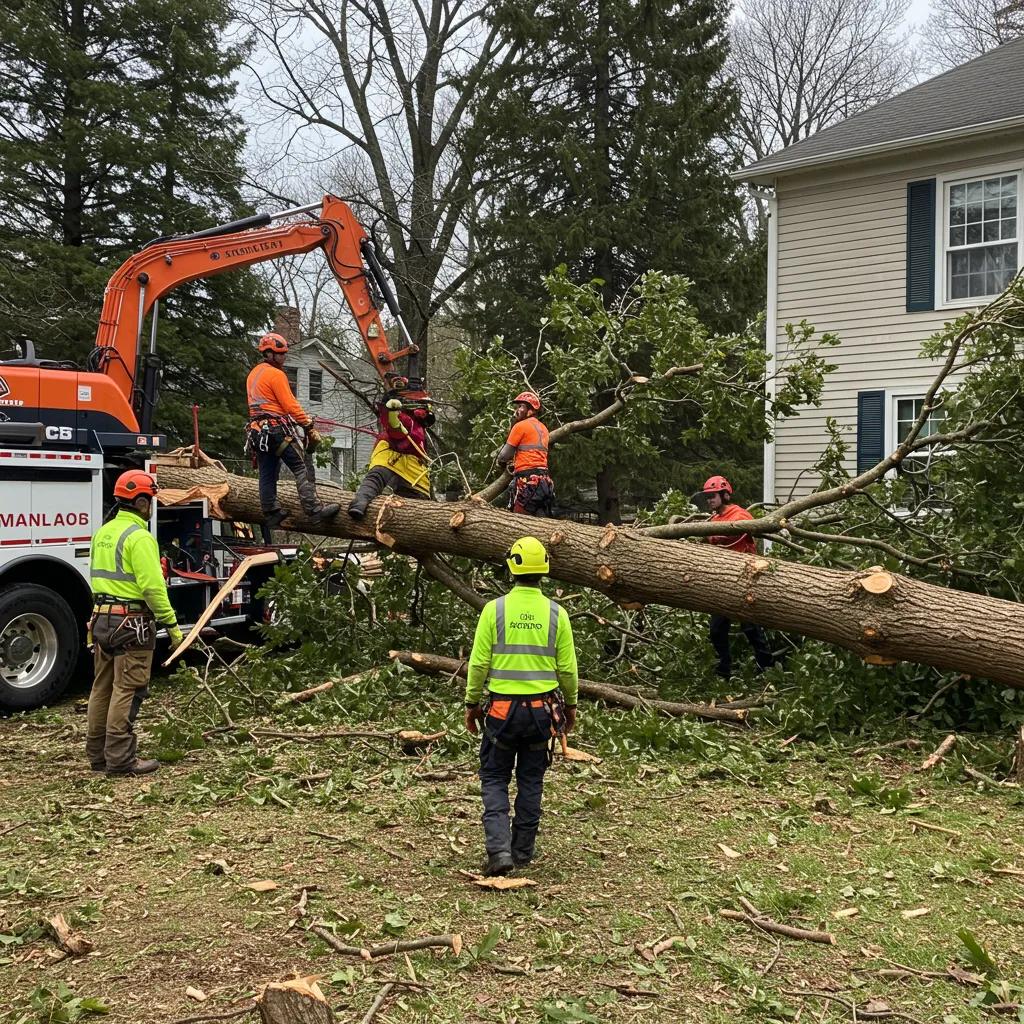
Call emergency tree removal services when a tree presents an imminent threat to life, structures, utilities, or safe access and cannot be safely managed by household means. Urgent scenarios include trees leaning into occupied structures, limbs or trunks resting on roofs, trees contacting power lines, or when progressive failure is evident and collapse is likely. Prompt professional response stabilizes hazards, prevents secondary damage like roof collapse or vehicle loss, and restores safe egress for occupants. The paragraph below lists clear red-flag conditions that require immediate contact and explains why rapid intervention matters.
- Tree leaning onto a home or garage and moving noticeably during wind events.
- Large limb or trunk on a roof, porch, or vehicle creating structural loading.
- Tree or branch entangled with live electrical lines.
- Progressive cracking or separation at the main stem or root flare suggesting imminent collapse.
When such conditions exist, calling a qualified emergency crew is vital because they bring rigging expertise, insurance and safety protocols, and the ability to stabilize or remove hazards quickly while minimizing collateral damage; Bushor’s Tree Surgeons provides 24-hour emergency service, free quotes, and a satisfaction guarantee to assist Jacksonville homeowners in these situations. (bushortree.com)
What Tree Conditions Require 24/7 Emergency Removal?
Conditions that need immediate removal include active structural failure (cracks widening, snapping noises), trees on occupied structures, trees blocking primary egress, and contact with power lines where utility coordination is required. Differentiate imminent hazards from non-urgent issues—such as isolated limb loss without structure contact—so emergency teams can triage effectively. While awaiting professionals, evacuate affected areas and keep bystanders clear, which reduces exposure to falling debris. Rapid, skilled removal reduces risk of injury and prevents progressive property damage.
How Does Emergency Tree Removal Protect Your Property and Family?
Emergency removal mitigates further collapse that could cause roof penetration, broken windows, or vehicle damage and reduces the chance of personal injury from sudden failure. A professional crew stabilizes the scene, performs controlled reductions, and implements temporary protections like tarping or shoring if structures are exposed. Prioritizing life-safety over cost prevents tragic outcomes and often reduces total financial loss by avoiding secondary structural failures that are more expensive to repair. Prompt response also documents actions taken, aiding insurer evaluations and speeding claim processes.
How Can Free Quotes and Satisfaction Guarantees Help Homeowners Choose Services?
Free quotes provide transparent scope and cost estimates so homeowners can compare options without upfront commitment, and a satisfaction guarantee indicates a service provider’s confidence in workmanship and safety compliance. When evaluating companies, request proof of insurance, ask about certified personnel (for example, ISA Certified arborists), and confirm emergency availability and typical response times. Comparing multiple quotes and vetting credentials protects homeowners from underqualified operators and helps select a provider who balances speed, safety, and fair pricing.
How Does Proactive Tree Care Save Homeowners Money and Prevent Costly Emergencies?
Proactive care reduces the incidence of high-cost emergency removals by addressing hazards early through periodic maintenance and targeted interventions, producing measurable savings over the life of trees. Preventative pruning, root protection, and regular risk assessments typically cost a fraction of emergency removal combined with structural repairs, insurance deductibles, and secondary damage remediation. The cost-comparison table below provides example ranges and the typical risk reduction associated with preventative measures versus emergency responses to help homeowners budget and prioritize work.
| Service Type | Typical Cost Range | Response Time / Risk Reduction |
|---|---|---|
| Preventative maintenance (pruning, inspection) | $150–$1,200 per visit | Scheduled; reduces risk of failure by 30–70% depending on scope |
| Structural cabling/bracing | $300–$2,000 | Planned installation; stabilizes targeted unions for multiple seasons |
| Emergency removal (large tree on structure) | $1,000–$5,000+ | Immediate; high cost due to urgency and access complexity |
| Tree health assessment | $75–$400 | Inspection report enables prioritized interventions and insurance documentation |
These ranges vary with tree size, access, and locality; investing in prevention often prevents a single emergency removal cost and reduces insurance claim frequency. Documenting maintenance and assessments also supports homeowner claims and can influence insurer evaluations of reasonable care.
What Are the Average Costs of Emergency Tree Removal vs. Preventative Care?
Emergency removal costs escalate due to overtime labor, complex rigging, and potential property protection measures; a structurally compromised large tree on a roof can exceed several thousand dollars in emergency fees plus repair costs. Preventative care—regular pruning, inspections, and limited corrective work—typically represents a predictable, budgetable expense that mitigates the most likely failure modes. Homeowners who exchange one unplanned large expense for routine, lower-cost maintenance generally see net savings and reduced disruption over time, making a strong fiscal case for scheduled tree care.
How Does Regular Tree Maintenance Reduce Insurance Claims and Property Damage?
Regularly scheduled maintenance reduces the likelihood of catastrophic failures that trigger claims, and thorough documentation of inspections and work performed provides evidence of reasonable care in the event of a loss. Insurers often consider documented maintenance when evaluating claims and may treat a well-maintained landscape as lower risk for certain perils. Keep dated photos, invoices, and inspection reports to demonstrate proactive stewardship if a claim arises, which helps clarify causation and supports fair claim resolution.
What Local Case Studies Demonstrate Successful Emergency Prevention in Jacksonville?
Local preventative examples often involve pre-season pruning and root-zone care that prevented uprooting during coastal storms or strategic removal of a single high-risk tree that protected adjacent homes during a hurricane event. In Jacksonville, timing preventative work ahead of peak hurricane months and prioritizing trees near primary structures has produced measurable reductions in emergency callouts for many homeowners. Documented cases show how modest investment in targeted pruning and an assessment-based intervention plan can avoid large emergency costs and protect family safety, reinforcing the value of a proactive approach.
If you want a free quote or to discuss proactive maintenance packages tailored for Jacksonville properties, Bushor’s Tree Surgeons offers free quotes, ISA Certified arborists, and 24-hour emergency service to help plan and implement preventative care. Call 904-789-8884 to request a consultation. (bushortree.com)
What Frequently Asked Questions Do Homeowners Have About Preventing Tree Emergencies?
This FAQ section answers common homeowner queries with concise, actionable guidance to capture quick reference needs and support decision-making about professional help. Short, direct answers help homeowners act quickly and know when to call for professional intervention.
How Can I Protect My House from Falling Trees and Branches?
Protect structures by removing or reducing nearby hazard trees, maintaining a buffer between crowns and roofs, and performing regular structural pruning to remove deadwood and weak unions. For high-value trees that are structurally compromised but desirable, professional cabling and bracing may provide temporary reinforcement while long-term decisions are made. Always document work and schedule inspections before storm season to minimize last-minute vulnerability; these steps lead into inspection frequency recommendations.
How Often Should Trees Be Inspected for Emergency Risks?
Most mature trees benefit from an annual inspection, while newly planted trees should be checked seasonally during establishment and high-risk trees should be evaluated after major storms or construction. Increase frequency for trees near structures or in coastal exposure where storm impacts and salt stress accelerate decline. A risk-based inspection schedule ensures resources are focused where they most reduce potential for emergency failure.
What Are the Signs That a Tree Needs Professional Attention?
Seek professional attention for large trunk cracks, widening splits, fungal conks, severe lean, root plate heave, or when major limbs are supported only by compromised unions. If you observe progressive decline or sudden changes after a stress event, arrange an inspection promptly and secure the area until a professional assessment is complete. These red flags help homeowners determine when immediate action is necessary and when routine maintenance suffices.
How Do Certified Arborists Perform Tree Risk Assessments?
Certified arborists combine visual assessment with diagnostic methods—soundings, targeted probing, and evaluation of soil and root conditions—to produce a risk rating and recommended mitigation. They document findings in reports with clear next steps (prune, monitor, cable, remove) and prioritize work by likelihood and consequence of failure. Deliverables typically include photographs, risk classification, and cost estimates to help homeowners plan interventions and budget appropriately.
What Steps Should I Take After a Tree Falls on My Property?
First, ensure no people are injured and keep clear of the area, especially if utilities are involved. Photograph the scene for insurance, call emergency services for utility threats, and contact a certified arborist for safe removal and damage mitigation. Do not attempt large removals yourself; professionals use proper rigging and safety systems to prevent secondary damage. These actions preserve safety and streamline recovery and claim documentation.
This article has provided the inspection checklists, maintenance priorities, and emergency guidance homeowners need to reduce tree-related hazards and protect property in Jacksonville. For professional assessments, emergency response, or a free quote from a locally operated company with ISA Certified arborists and 24-hour emergency service, call Bushor’s Tree Surgeons at 904-789-8884. (bushortree.com)